
Nano Nozzle: A Showcase of Extreme Precision in Micro Component Manufacturing
The Nano Nozzle was developed to exhibit extreme precision machining capabilities through a range of machining methodologies. The part was processed through several work centers, including Swiss machining, micro wire EDM, micro EDM milling, and femtosecond laser processing. Machining methods are sensibly chosen by Nanotech Precision based on the specific needs of various machining scenarios. Having a variety of manufacturing work centers in-house is what gives Nanotech Precision the ability to efficiently manufacture the highest quality, ultra-fine precision parts and components with micro features, as demonstrated by the Nano Nozzle.
Swiss Machining: Foundation of Micro Component Manufacturing
Swiss machining is a manufacturing process for high-volume production of small and micro components. The term Swiss machining is used in reference to equipment using a sliding headstock and a guide bushing to feed material into a cutting tool such as a turning tool or drill. Stock material is usually precision ground bar stock up to to 4 m in length and under 38 mm in diameter. Nanotech Precision generally utilizes bar stock at 3 mm in diameter but has used bar stock down to 1.5 mm and as large as 15 mm in diameter. Diameter accuracy of the finished part is usually reflective of the quality and accuracy of incoming material. Nanotech Precision utilizes precision ground bars to enable the best control of the diameter and roundness.
Swiss lathes are designed to be highly accurate and repeatable, making them a cornerstone in reliable micro component manufacturing. Through programming and setup, it is not uncommon to see tolerances down to ± 5 µm in diameter and ± 12 µm in length. Although it is possible to achieve even closer tolerances, this is where high-volume repeatability starts to deteriorate due to tool wear and machine capabilities. The number of close tolerance features can greatly affect repeatability. Swiss lathes provide an advantage over traditional turning equipment by keeping the tools as close to the material-supporting guide bushing as possible. This reduces deflection almost entirely and allows for workpieces to be much smaller in diameter, greater in length, or both. For example, a traditional lathe could not turn a part that is 635 µm in diameter by 100 mm in length because the material would deflect or need to be re-chucked and turned in very small sections, whereas a Swiss lathe can do this in one fluid motion.
Nanotech Precision has a variety of Swiss lathes and turning machines with very different capabilities ranging from very basic to highly complex. This allows Swiss programmers to select a machine that’s perfectly matched to the workpiece being created. Combining this equipment with best machining practices, knowledgeable staff, and the most capable programmers available, Nanotech Precision can produce extremely small, tight tolerance parts that many traditional machining companies cannot.
Swiss Machining in Micro Component Manufacturing of the Nano Nozzle
Machine selection, Swiss programming and set up were the first steps to Swiss machine the Nano Nozzle. The machine was selected by reviewing the types and numbers of tools needed, live tool capabilities for both main and sub spindle, and spindle speed needs for both the workpiece and the live tooling. These were all determined based on the size and tolerances of the part.
Once an appropriate machine was selected, programming began with a determination of the best orientation of the part. The capability of the machine, tooling, and an effort to create “free time” by utilizing sub spindle side tooling that can work simultaneously while the main spindle runs were all considerations that needed to be made.
After programming was completed, setup began for the tooling and raw material. Setups are typically standard across various Swiss lathes. A turn tool is mounted into a machine and adjusted for diameter, centerline, and Z axis locations, and drills are touched off to a machined surface or diameter for location.
Utilizing carbide turning tools to Swiss turn the outside diameters, carbide grooving tools to machine the grooves, and carbide drills to drill the hole, the Swiss lathes began cutting at high RPM’s, removing material as necessary. All the outside diameters, grooves, overall length, corner breaks, and the inside 762-µm drilled hole of the Nano Nozzle were completed in the Swiss lathe.
The image below shows the Nano Nozzle following completion of the Swiss machining process.

Micro Wire EDM: Accuracy & Reliability
After the Swiss machining process was completed, the part was cleaned and passed to the next machining work center, micro wire EDM. Micro wire EDM (electrical discharge machining) is a non-contact machining method that consistently provides ultra-high precision results. This method is especially advantageous for micro machining due to the high level of control of the electrical discharge process as well as the high accuracy motion control of the equipment and controlled process temperature. Machining or ablation occurs with a controlled discharge of electrical current between the wire electrode and the grounded workpiece, allowing complex geometries through a wide range of thicknesses. Tolerances can be held as fine as ± 1 µm and feature sizes down to 38 µm.
Controlled by the machine parameters, a high-energy discharge that vaporizes the workpiece material is created during the EDM process. The pulse duration and energy vary depending upon the requirements of the workpiece and differ between a roughing operation verses a finishing operation. The workpiece is submerged in either water or oil-based dielectric.
The dielectric acts as a resistor and is used for controlling the process and workpiece temperature as well as a means of flushing the particulate away from the ablation process. Oil dielectric delivers accurate results among a wide variety of materials with a very small spark gap to produce micro features and extremely precise control to hold accurate tolerances.
The repeatability of the wire EDM equipment in the instance of the Nano Nozzle is ± 1 µm. Process accuracy of ± 2 µm is consistently achieved with program and technology refinement.
“The repeatability of the wire EDM equipment in the instance of the Nano Nozzle is ± 1 µm.”
It’s All About The Fixture
A crucial component of the wire EDM machining process is designing and employing a precise fixture so that circular parts or irregularly shaped components can easily be taken ahold of. Most often, components run through Swiss machining before wire EDM takes place. Even the slightest out of round part can pose a challenge for fixturing repeatability. Micro parts are also very delicate and too much fixture pressure can damage or scratch a part. Ensuring accuracy and precision of the fixture is critical in the wire EDM machining process. Open communication between work centers is essential for producing successful, high-quality parts.
Design elements were carefully considered when developing the high precision fixture for the Nano Nozzle. First, a durable fixture needed to be developed that would easily load, unload, and mount. A second consideration was that the part had features on three sides. The part needed to be held firmly but allow the wire to approach from each side of the component. The fixture also needed to hold the part datum evenly and vertically, which was 1.1 mm in diameter.
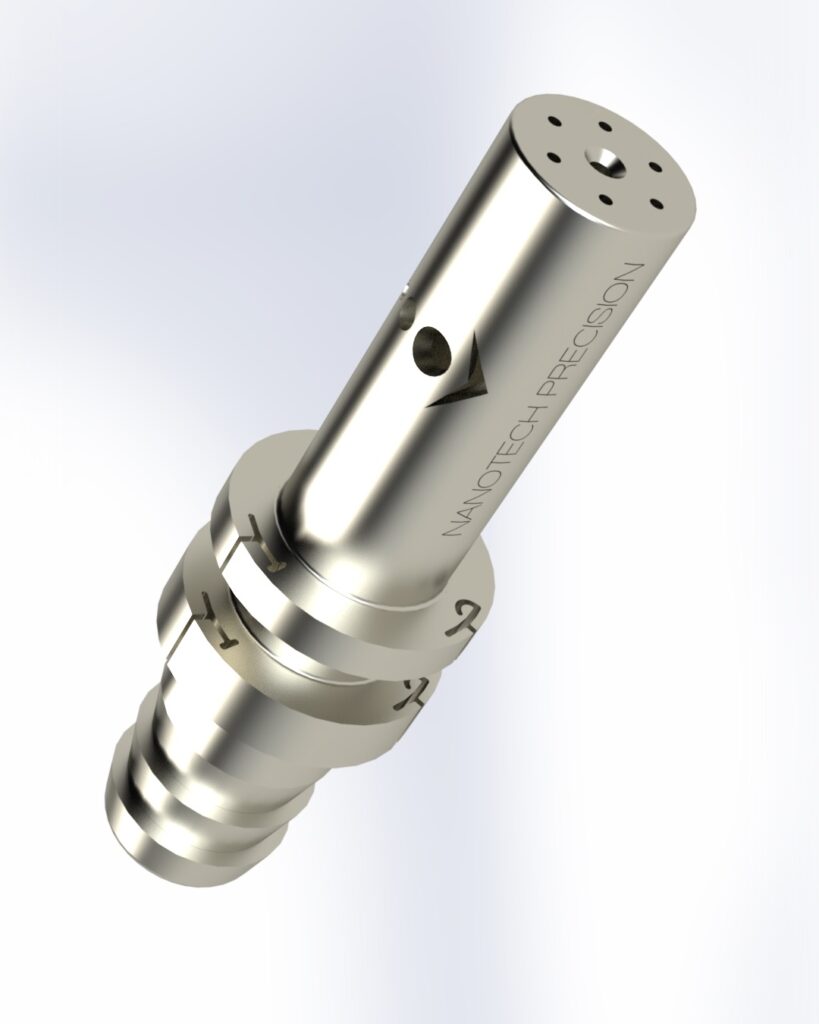
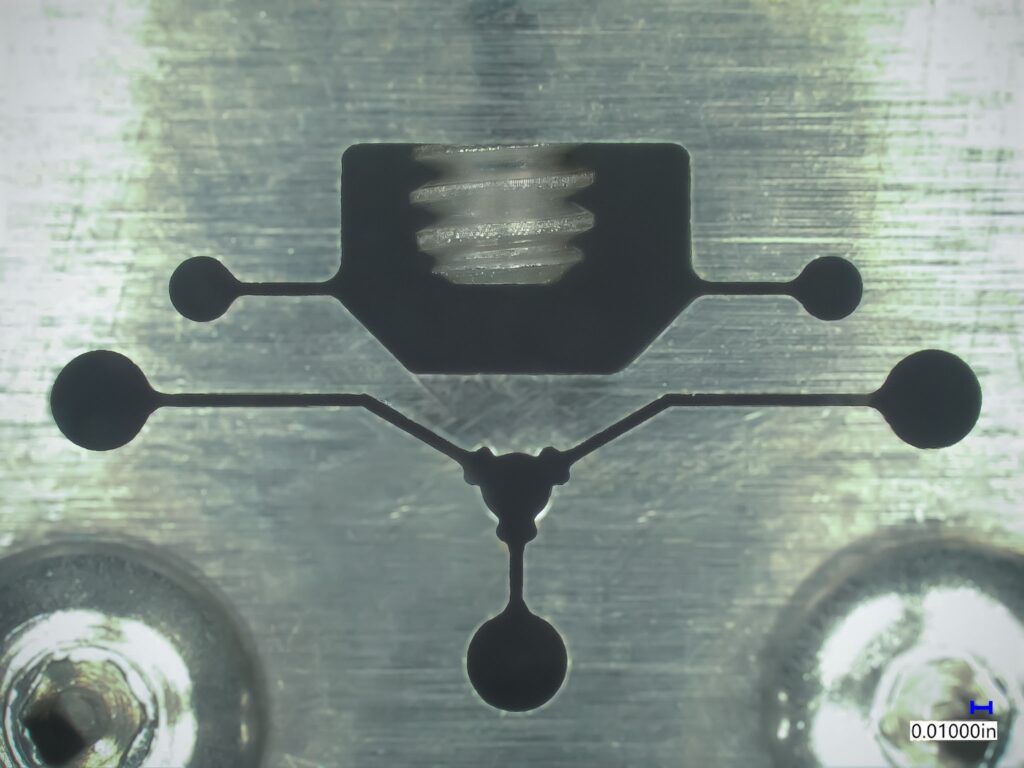
Electrode wire diameter is typically chosen based on the feature sizes within the component. In the case of the Nano Nozzle, 38 µm was the smallest feature, so 30-µm wire was used. To machine the edge trim, 100-µm hole, and the ‘T’, and the ‘P’ features in the Nano Nozzle, the 30-µm wire was first threaded through start holes in the fixture. Next, the wire entered the part utilizing trimming technology, followed by a contour to cut the shape. This process was repeated three times, 120 degrees apart. See the completed Nano Nozzle below on the left, and a close-up of the high precision fixture on the right.
Micro EDM Milling: Fine-Tuned Micro Machining
Following micro wire EDM, the Nano Nozzle went to micro EDM milling for processing. Micro EDM is a process specifically developed for micro machining and it involves a small rotating electrode that can be sized or shaped to the requirement of the task to be accomplished. The workpiece is presented to the electrode and subjected to electrical discharge to remove material from the workpiece. For example, if the operation required a 30-µm diameter hole, the electrode would be shaped at 24-28 µm and plunged into the workpiece at the location required. Or, if the operation required a slot at 70 µm, the electrode would be sized accordingly and applied to the workpiece and manipulated to meet the requirements.
In the case of the Nano Nozzle, the electrode needed to be shaped at a 45-degree angle to machine the chamfer of the 125-µm diameter center hole. A pick-up routine was used to find the part center and Z height, and the oscillating plunge turned into the part to make a cut, completing the 45-degree, 230-µm cone feature.
Ultraprecise EDM Equipment
The Wire ED equipment used in the processing of the Nano Nozzle is specially designed for micro machining. It has submicron positioning accuracy and is designed to operate with wire sizes down to 20 or 30 µm in diameter. The wire electrode is generally brass with varying levels of copper and zinc. Smaller diameter wire can be tungsten or molybdenum composition. In some cases, the wire will have a steel core with brass or zinc coating, and workpiece material always needs to be electrically conductive.
Nanotech Precision uses EDM equipment and machinery of the highest accuracy with digital control of the EDM process for reliability and repeatability. The micro ED milling machine design is also specific to the requirements of micro machining. The machinery provides the positional accuracy and stability of machine movements as well as process control required for generating and monitoring electrical discharge at a micro scale, holding up to 0.1 µm location. This combination provides the capability to plunge, orbit, and produce features such as holes, slots, bosses, flats, cones, etc. under 25 µm with surface finishes measured in nanometers Ra.
Femtosecond Laser Machining
Once the micro EDM process was complete, the final machining process could begin – femtosecond laser processing. Femtosecond laser ablation is especially advantageous for micro machining due to the ultra-fast pulse, extremely small spot size, and high energy. Laser ablation is more accurately defined as multi-photon ionization where very intense pulsed lasers combine the energy of many photons to ionize an atom. Femtosecond lasers emit pulses with a duration of 10⁻¹⁵ of a second, or one quadrillionth of a second.
The high energy and ultra-short pulse provide relatively fast ablation without heat being absorbed into the workpiece. The resulting effect on materials being ablated is generally a tremendously clean cut with no heat affected zone (HAZ) and minimal if any burr. Edge quality and wall conditions with near mirror finish are advantages of ultrafast laser processing, as well as the flexibility to machine a wide variety of materials such as polymers, ceramics, biomaterials, and metals to an extreme level of precision. The small beam size works magnificently for fine features, and the overall accuracy and repeatability of the system to achieve submicron tolerances make micro machining ultra-efficient.
Additional machining capabilities of the femtosecond laser include micro cutting, laser chamfering and radiusing, as well as three-dimensional (3D) profiles. The ultra-fast pulse of the laser also provides the ability to machine positive, negative, and zero taper holes with an extremely clean finish. The accuracy and repeatability of the machine platform are +/-1 µm, and the accuracy and repeatability of the laser and scanner combination are submicron.
Ultrafast Laser Processing
When determining the laser workholding for the Nano Nozzle, issues such as the outer diameter of the part, the length available to grab onto with a collet, as well as clearance for standoff needed to be taken into consideration. To determine the laser parameters, matters such as ablation threshold of material, feature size and depth, as well as adjacent surfaces to the features being machined all needed to be considered. During the femtosecond laser processing of the Nano Nozzle, the ablated materials went through an instantaneous phase transition from a solid to a vapor.
Laser hole drilling and machining was completed to make the six 76 µm-diameter holes on the end of the part and company logo.
The company name within the logo was laser engraved. To create the micro features, the machine platform’s turret tilted and rotated the workpiece, and the scan head’s Galvo mirrors and precession parameters manipulated the beam.
Experts in Micro Component Manufacturing
The Nano Nozzle was designed to demonstrate the unique micro component manufacturing capabilities of Nanotech Precision, using equipment of the highest quality, accuracy, and reliability. See a close-up view of the ultra-precise component features below. While it is not necessarily unique to simply Swiss turn a micro component, utilize micro EDM/micro wire EDM or femtosecond laser processing to machine a component, what is unique is the knowledge and skill to determine the best combination of these capabilities to manufacture a micro component with extreme precision. Complex manufacturing of micro components while holding tight tolerances and high repeatability in production volumes is Nanotech Precision’s expertise.

Ready to see how Nanotech Precision can bring extreme accuracy to your micro components? Contact our team today to discuss your project.
Ready to get started?
Get In Touch
Join Our Team!